Ordinary matter is ultimately composed of elementary particles (quarks and leptons), and the Standard Model is the theory that describes how these elementary particles interact through three of the four fundamental forces of the universe (strong, weak, and electromagnetic). However, several questions still challenge this theory: the incorporation of the gravitational force, the origin of Dark Matter, the origin of the generations of quarks and leptons and their mass scales, the matter–antimatter asymmetry, and the properties of neutrinos.
Experimental answers to these questions are pursued at High-Energy Experimental Physics facilities. Researchers at UAM are involved in precision measurements of the Standard Model as well as searches for new physics at the Large Hadron Collider (LHC) and in neutrino experiments such as Super-Kamiokande and NEXT.
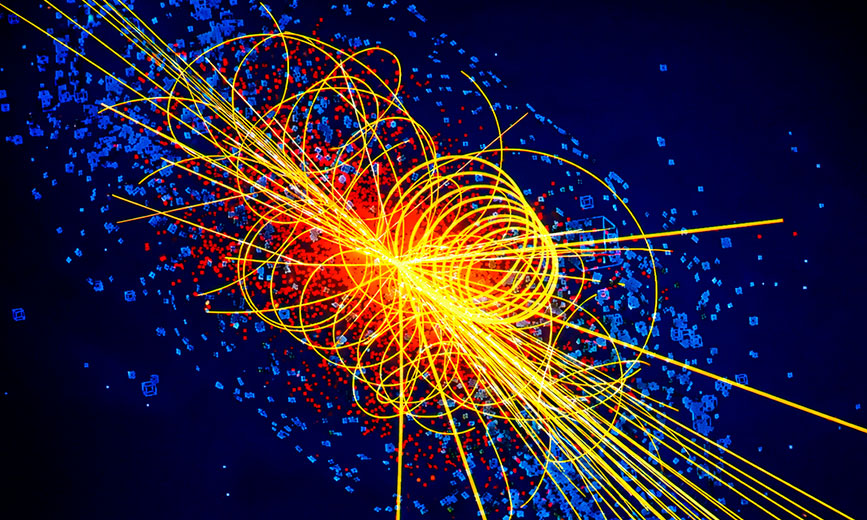
ATLAS and CMS are two (of the four) experiments/detectors/collaborations that collect the results of particle collisions at the LHC. Members of this research line actively participate in these collaborations through data analysis, the development of the ATLAS liquid-argon electromagnetic calorimeter, and the CMS muon drift tubes. In addition, a Tier-2 computing facility belonging to the Worldwide LHC Computing Grid provides support for simulation and data processing for end users.
Neutrinos are produced in a given “flavor” (electron, muon, or tau) that does not correspond to a definite “mass eigenstate.” This fact is the origin of neutrino oscillations. Members of this research line participate in experiments such as Super-Kamiokande and NEXT, which aim to detect and study the properties of neutrinos, and to search for possible proton decay and neutrinoless double beta decay.
Associate Researchers
- Barreiro Alonso, Fernando – Catedrático Emérito de Universidad UAM
- Cueto Gómez, Ana R. – Investigadora Ramón y Cajal UAM
- Del Peso Malagón, José María – Profesor Titular de Universidad UAM
- Fernández de Trocóniz Acha, Jorge– Profesor Titular de Universidad UAM
- Glasman Kuguel, Claudia Beatriz – Profesora Titular de Universidad UAM
- Labarga Echeverría, Luis – Catedrático de Universidad UAM
- Terrón Cuadrado, Juan – Profesor Titular de Universidad UAM
External Researchers
- Cárdenas Montes, Miguel – C. I. Energéticas Medioambs. y Tecns. , CIEMAT
- Casaus Armentano, Jorge – C. I. Energéticas Medioambs. y Tecns. , CIEMAT
- Cepeda Hermida, María L. – C. I. Energéticas Medioambs. y Tecns. , CIEMAT
- Cuesta Soria, Clara ; C. I. Energéticas Medioambs. y Tecns. , CIEMAT
- De Roeck, Albert; CERN and University of Antwerp, Belgium.
- Gil Botella, Inés – C. I. Energéticas Medioambs. y Tecns. , CIEMAT
- Giovacchini, Francesca – C. I. Energéticas Medioambs. y Tecns. , CIEMAT
- Goy López, Silvia – C. I. Energéticas Medioambs. y Tecns. , CIEMAT
- Hernández, José M. – C. I. Energéticas Medioambs. y Tecns. , CIEMAT
- Tengblad, Olof – Instituto de Estructura de la Materia, IEM-CSIC